
How New H-1B Policies Could Hurt the U.S.—and the Indian-American Success Story
By Anjali V. Deshmukh
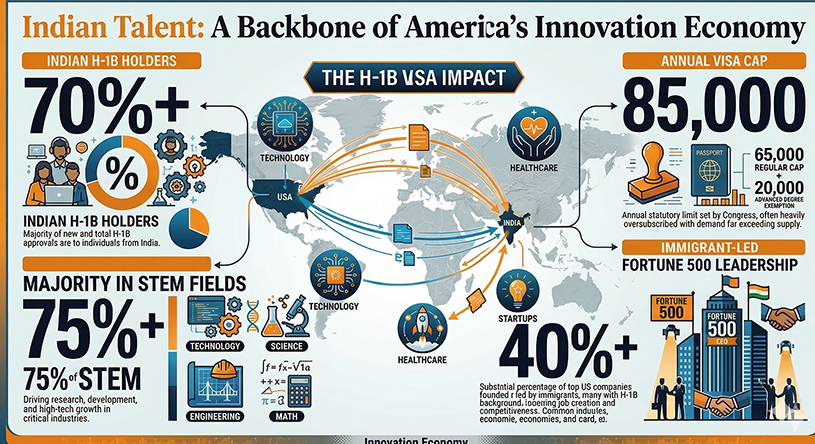
For decades, the H-1B visa program has served as a powerful economic bridge between the United States and India, fueling innovation, entrepreneurship, and global leadership. Indian professionals—particularly in technology, healthcare, engineering, and research—have played a transformative role in shaping modern America. From Silicon Valley startups to Fortune 500 boardrooms, Indian-origin talent has contributed not only skills, but vision, resilience, and a deep commitment to growth.
However, recent policy shifts under the Trump administration threaten to disrupt this mutually beneficial relationship. By sharply increasing costs, restricting access, and restructuring how visas are allocated, these changes risk undermining U.S. economic competitiveness while weakening one of the most successful immigrant success stories in American history.
At the heart of the issue is a fundamental misunderstanding: restricting high-skilled immigration does not protect the U.S. economy—it constrains it.
Key Challenges
 Recent changes to the H-1B program risk undermining U.S. economic and strategic interests in several critical ways:
Undermining U.S. Competitiveness
Restrictive H-1B policies are not eliminating demand for talent—they are simply redirecting it. Research suggests that for every rejected H-1B visa, companies hire between 0.4 and 0.9 skilled workers abroad. This means jobs that could have been created in the United States are instead moving overseas. For Indian professionals—who form a significant portion of the H-1B workforce—this shift could accelerate the growth of global innovation hubs in cities like Bengaluru, Hyderabad, and Toronto. Strategic sectors such as artificial intelligence, cloud computing, semiconductors, and biotechnology are particularly vulnerable. By limiting access to global talent, the U.S. risks losing its leadership position in the very industries that will define the future.
Weakening the Labor Market
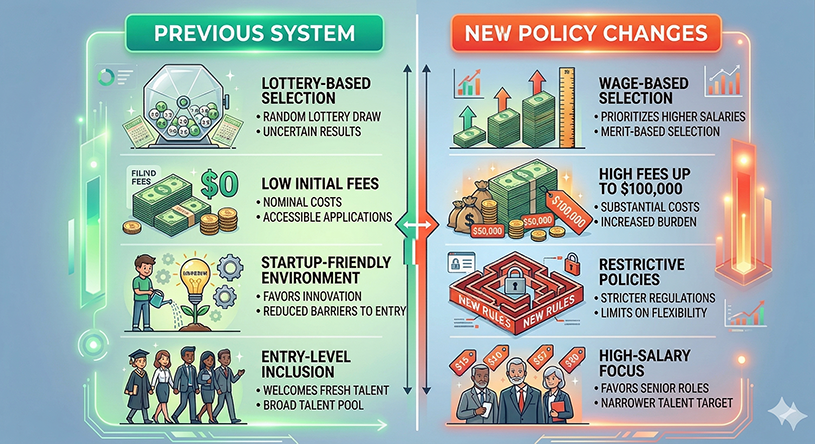
The introduction of dramatically higher H-1B-related fees—reportedly reaching up to $100,000 in some cases—creates a major barrier for employers. At a time when the U.S. is already facing shortages in STEM talent, healthcare professionals, and specialized engineers, restricting this pipeline is counterproductive. Indian professionals have historically filled critical gaps, often enabling companies to expand operations and hire more American workers in complementary roles. Limiting their entry will not solve labor shortages—it will deepen them, slowing innovation and increasing costs across industries.
Harming Employers—Especially Small and Mid-Sized Businesses
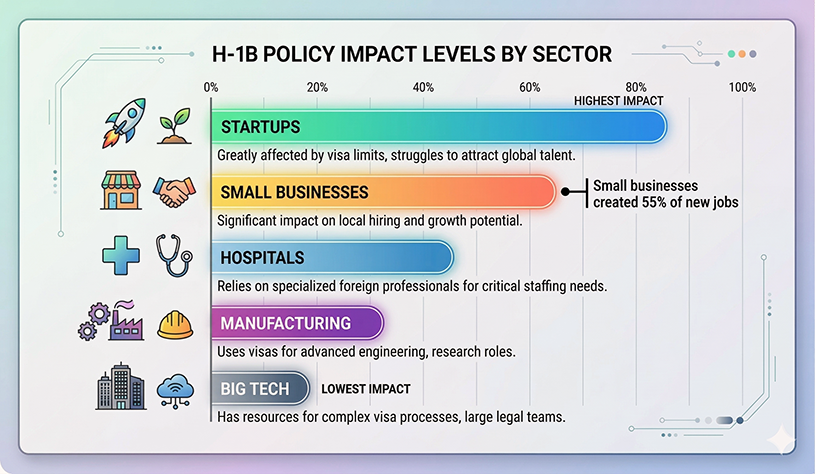
The burden of these policy changes will fall disproportionately on smaller organizations. While large tech giants may be able to absorb higher hiring costs, startups, small businesses, hospitals, and manufacturing firms will struggle. These organizations rely heavily on access to skilled talent to remain competitive and grow. With six-figure hiring costs, many will be forced to either scale back hiring or shift operations overseas. This is particularly alarming given that small businesses have contributed approximately 55 percent of net job creation in the United States over the past decade. By limiting their access to talent, these policies risk stifling one of the most dynamic drivers of economic growth.
Misaligning Visa Allocation with Strategic Needs
The shift toward a wage-based selection system introduces another structural problem. By prioritizing applicants offering the highest salaries, the system assumes that compensation is the best measure of value. In reality, innovation often comes from early-career professionals, researchers, and specialists working in emerging fields. Many Indian engineers and graduates enter the workforce at this stage and go on to become entrepreneurs, CEOs, and pioneers of new technologies. By crowding out this group in favor of higher-paid, often more established roles, the policy risks undermining long-term innovation and economic vitality.
The Indian-American Contribution
The Indian-American community stands as one of the most compelling examples of the success of high-skilled immigration. With some of the highest levels of education and professional achievement in the country, Indian-Americans have made outsized contributions across sectors. They lead major technology firms, drive medical innovation, build successful businesses, and contribute to academia and public service.
Many of these success stories began with an H-1B visa. What starts as an opportunity for a young engineer or doctor often evolves into entrepreneurship, job creation, and long-term community leadership. By restricting access to this pathway, the U.S. risks breaking a cycle that has consistently delivered economic and social returns.
A Global Shift in Talent
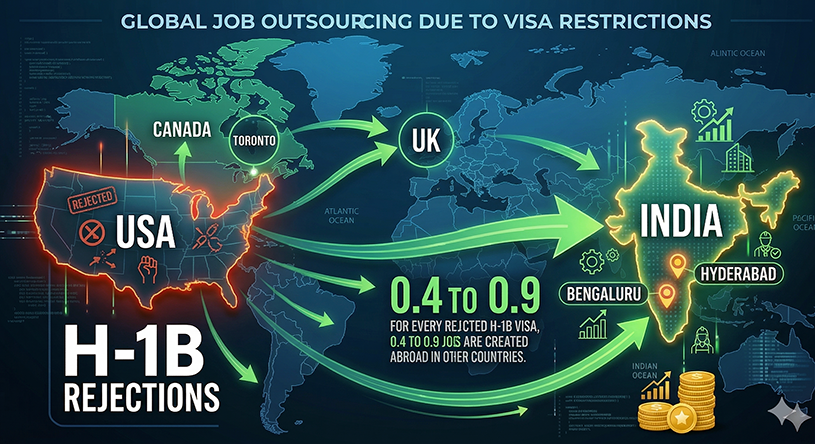 Perhaps the most significant long-term risk is the global redistribution of talent. Countries such as Canada, the United Kingdom, and Australia are actively designing immigration systems to attract the very professionals the U.S. is now discouraging. At the same time, India itself is rapidly emerging as a global innovation hub, offering increasing opportunities for skilled professionals to thrive domestically.
If the U.S. becomes less accessible, the world will not run out of talent—it will simply relocate. Companies will follow. Investments will follow. And over time, leadership in key industries may follow as well.
A Better Path Forward
A more strategic approach would recognize that high-skilled immigration is not a threat but a national asset. Instead of broad restrictions, policymakers should focus on targeted reforms—supporting startups and small businesses, aligning visa allocation with critical industries, and ensuring that early-career talent continues to have opportunities to contribute.
Encouraging mobility within the labor market, reducing bureaucratic hurdles, and maintaining America’s reputation as a welcoming destination for global talent are essential steps in preserving long-term competitiveness.
The new H-1B policies may be driven by a desire to protect American workers, but their unintended consequences could be severe. By raising costs, limiting access to talent, and encouraging businesses to look abroad, these changes risk weakening the very foundation of U.S. economic strength.
For the Indian-American community, this is not just a policy issue—it is a turning point. It challenges a legacy built on contribution, opportunity, and mutual growth between two great nations.
In a global economy defined by knowledge and innovation, the choice is clear: nations that attract talent will lead, and those that restrict it will fall behind.
Anjali V. Deshmukh
Anjali V. Deshmukh is an immigration lawyer in Washington, D.C. who has been working in the field for more than 15 years. She focuses on employment and religious worker visas. She graduated from Georgetown University Law Center and has spent her career helping South Asian non-profits and cultural institutions understand the complicated rules and regulations that govern immigration in the United States. Anjali speaks at national legal forums a lot, and she cares deeply about giving the Indian-American community the legal clarity it needs to protect its rich spiritual and cultural traditions. You can reach her by email at anjali@deshvidesh.com.