

Trump, MAGA, and the Targeting of Indian-Americans
By Raj Shah
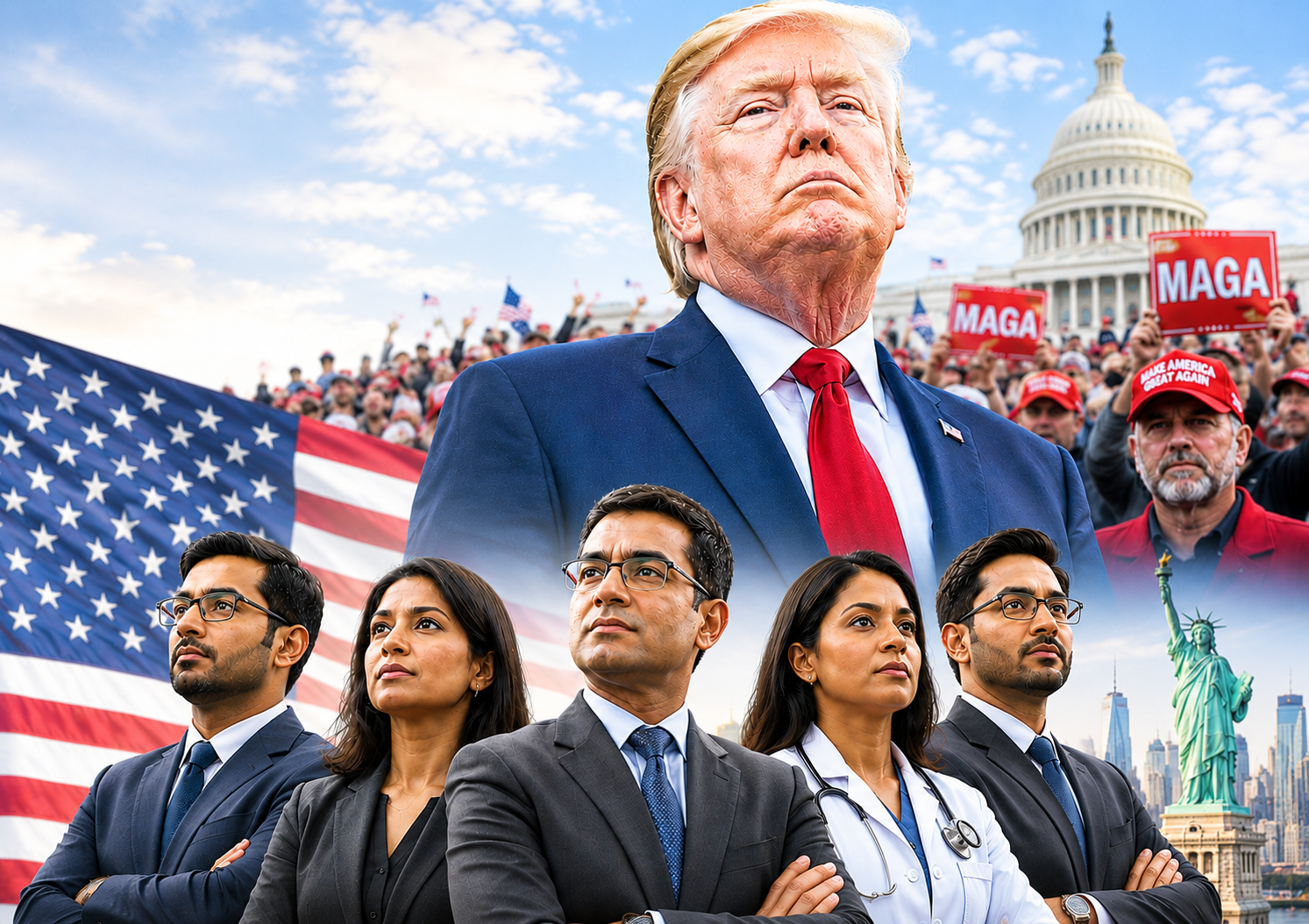
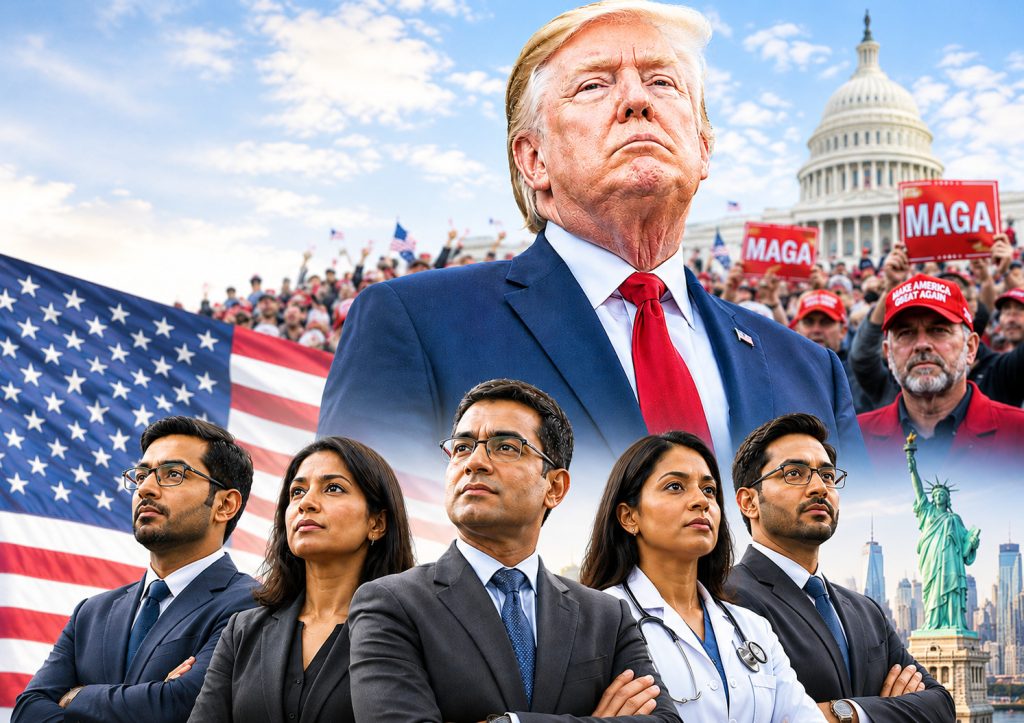
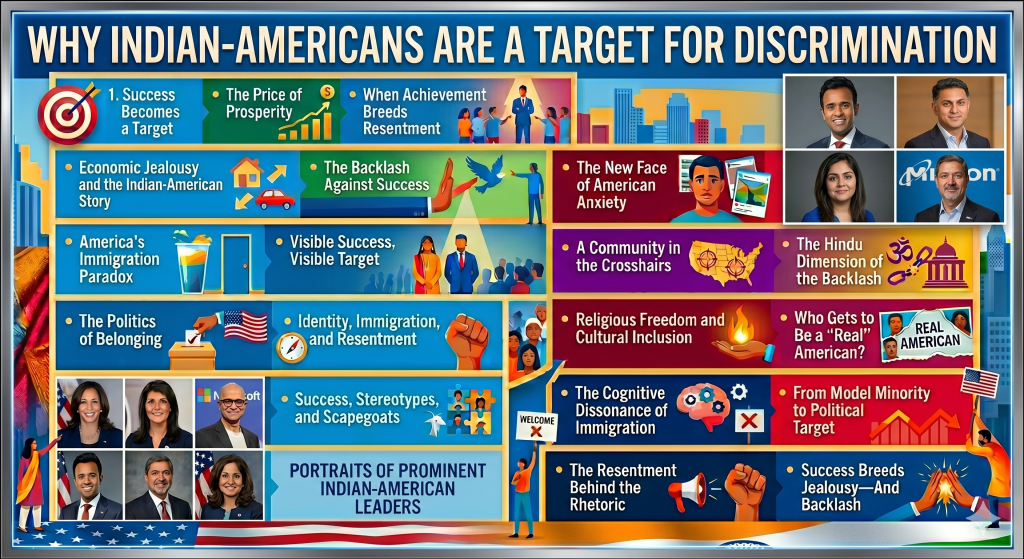
Indian-Americans are often called one of the remarkable immigrant success stories in America. They have long been called a model minority. They earn more than any other ethnic group in America. They run top companies. They teach in top universities. For decades, this success story stayed mostly out of the political fight. That is changing now. Online hate against Indian-Americans is rising fast. Many community members believe that President Donald Trump’s policies and statements are exacerbating the situation.
But success doesn’t always mean acceptance.
In the last few years, more and more Indian-Americans say they face discrimination and harassment. A 2026 survey found that almost half of Indian-Americans have experienced some form of bias. At the same time, anti-Indian and anti-Hindu comments have grown louder online, especially around the H-1B visa program.
Why is this trend happening?
Dr. Adit Adityanjee, President of the Council for Strategic Affairs, tackled that question in an interview with Dhairya Maheshwari of Daily Geopolitics. He looked at the politics, the economics, the culture, and the history behind the backlash.
His answer was simple.
“Indian-Americans are the highest-paid income group in America,” he said. “Success breeds jealousy. That is definitely an economic issue.”
Money is not the only factor. But it explains part of why America’s culture wars have now ensnared a community once celebrated as a model minority.
A Post That Shocked Many
Things got worse in April 2026. President Trump shared a post on Truth Social with comments from radio host Michael Savage. The post called India and China “hellholes.” It claimed Indian and Chinese immigrants were taking jobs from Americans. It also mocked their English and said they only hired their own people.
People reacted fast.
India’s Foreign Ministry called the comments “uninformed, inappropriate, and in poor taste.” The Hindu American Foundation called them racist. Congressman Ami Bera said they were “offensive, ignorant, and beneath the dignity of the office.”
Congressman Raja Krishnamoorthi introduced a House resolution against this kind of rhetoric. He warned it fuels discrimination against Asian-Americans.
For many Indian-Americans, none of the rhetoric was a shock. It felt like one more chapter in a pattern they’d already seen.
Dr. Adityanjee says the hate didn’t start with one post.
“There has been a force multiplier since Trump’s second term started,” he said. “Existing prejudices have become more visible and more openly expressed.”
A Rising Wave of Online Hate
 The “hellhole” comment wasn’t the start. Prominent Indian-Americans had already been getting hit with abuse online.
When FBI Director Kash Patel posted a Diwali message, some people told him to “go back home.” The same thing happened to Vivek Ramaswamy, Nikki Haley, and even the official White House accounts.
Researchers say anti-Indian content online has spiked. Most of it targets immigration, religion, and stereotypes about Indian culture.
This phenomenon is no longer confined to obscure corners of the internet. It’s showing up in mainstream politics.
Dr. Adityanjee says many Indian-Americans now feel like an easy target—for things that wouldn’t be tolerated against other groups.
Why Indian-Americans?
Dr. Adityanjee’s answer starts with success.
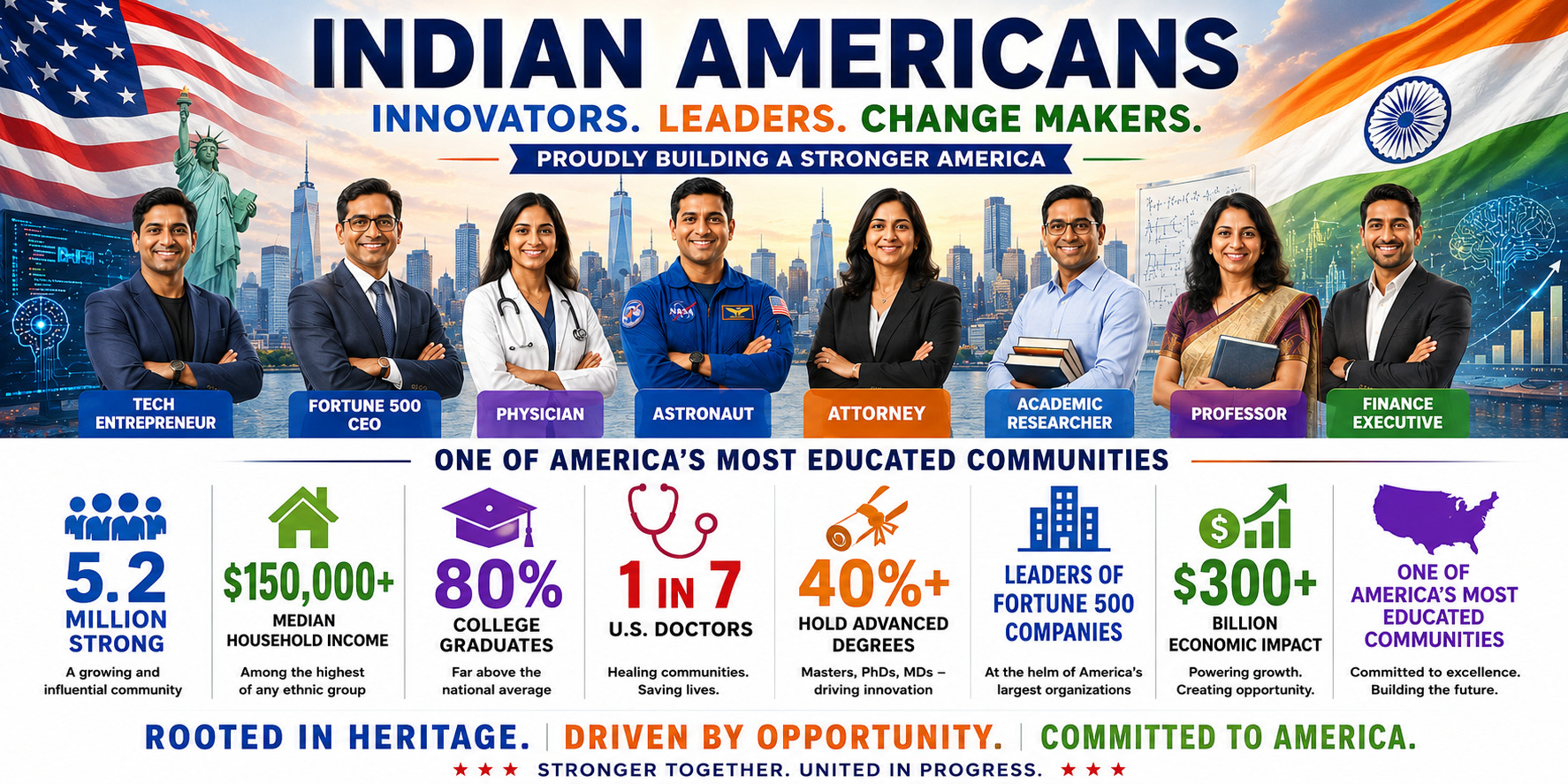
Indian-Americans top almost every economic chart. Median household income is over $150,000. More than three-quarters have a bachelor’s degree or higher. They’re everywhere in medicine, tech, finance, academia, and business.
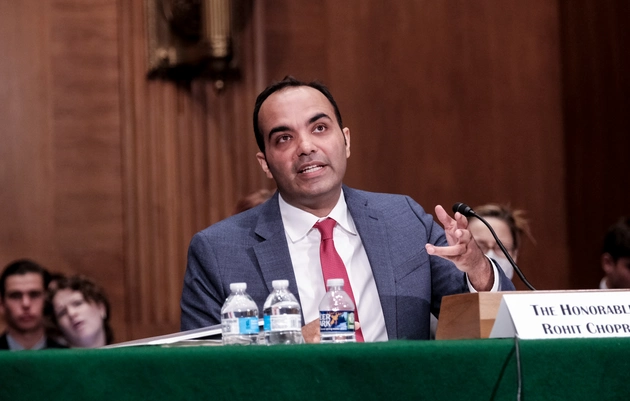
Professor Rohit Chopra of Santa Clara University says success itself draws resentment. Dr. Adityanjee agrees.
“When a community becomes highly successful, highly educated, and highly visible, it attracts attention,” he said. “Unfortunately, success can also attract resentment.”
This isn’t new. Throughout history, successful minorities have often become targets during hard economic times.
But Dr. Adityanjee sees something deeper.
“The United States is a country built by immigrants,” he said. “Yet many people still believe they are the only ‘real Americans.’ There is cognitive dissonance there.”
That contradiction sits at the center of today’s anti-immigrant feelings. America celebrates immigration in theory. In practice, some people are uneasy when newer immigrants succeed and become visible.
Indian-Americans are visible. They have achieved the American dream through education, hard work, business, and success.
That’s exactly what makes them a target.
“When people see successful brown-skinned professionals buying homes, driving luxury cars, running businesses, and building places of worship, there is anger, there is anguish, there is jealousy, and there is hatred,” Dr. Adityanjee said.
The Hindu Dimension
Religion adds another layer.
Many Indian-Americans are Hindu. Temples, cultural centers, and Diwali celebrations have grown considerably over the last twenty years.
Dr. Adityanjee pushes back on the idea that America belongs to one religion.
“The Constitution is secular,” he said. “It does not say America is a Judeo-Christian country. Every citizen is entitled to practice their faith.”
Still, anti-Hindu comments are common online now. Hindu festivals and Hindu public figures get mocked in ways that go past normal political debate.
For many Hindu Americans, the issue isn’t disagreement. It’s exclusion—feeling treated as less American because of their faith.
The H-1B Flashpoint
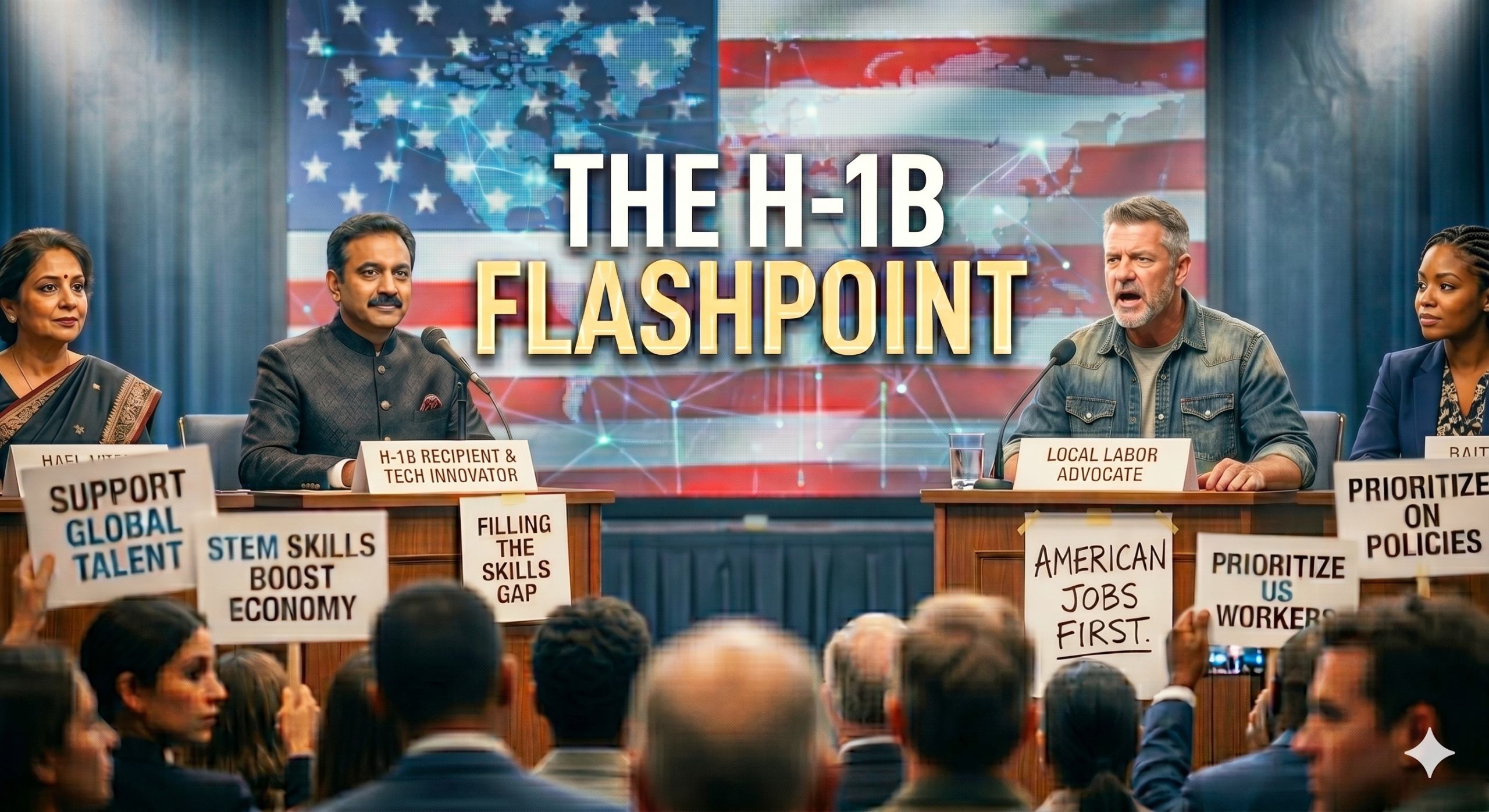 No issue captures the tension better than H-1B visas.
Indian nationals get most of these visas, which let skilled foreign workers fill jobs in tech, engineering, healthcare, and science.
Anti-immigration activists have targeted the program for years.
Critics say it steals American jobs. Supporters say it fills gaps the U.S. can’t fill on its own.
Dr. Adityanjee rejects the idea that Indian professionals are a threat.
“These are smart professionals,” he said. “They deserve the respect that is due to them.”
He points to the dozens of billion-dollar companies founded by Indian entrepreneurs and the thirty-plus major U.S. corporations now run by Indian-origin CEOs.
“This phenomenon is one of the greatest success stories of modern immigration,” he said.
But H-1B holders keep getting painted as job thieves or scammers.
The rhetoric has gotten sharper under the Trump administration. Critics often hold up Indian tech workers as the face of what’s wrong with immigration.
Dr. Adityanjee says many Indian-Americans feel singled out in these fights.
When Hate Moves Offline
What worries people most is that online hate doesn’t stay online.
In Texas, protesters carried signs reading “Don’t India My Texas” and “Deport H-1B Visa Scammers.” In Florida, local politicians have called for deporting Indian-Americans. Across the country, groups have tracked harassment, workplace discrimination, and public confrontations.
In one case, a Texas man told two Indian-American women he was glad they were being deported. A restaurant customer in Virginia verbally assaulted businessman Salil Maniktahla and pursued him outside.
Dr. Adityanjee says political rhetoric helps create this environment.
“The bar has definitely been lowered,” he said.
He supports a government’s right to enforce immigration law. But he draws a line between policy and prejudice.
“If you start harassing people because of their ethnicity, religion, or skin color, that should not be acceptable,” he said. “That is not an immigration issue. That is a civil rights issue.”
Anti-India or anti-Indian-American?
 One key point from the interview: there’s a difference between criticizing India’s policies and attacking Indian-Americans.
Dr. Adityanjee agrees that trade fights and political disputes between governments are normal. Every country looks out for its own interests.
However, ordinary Indian-Americans should not bear the consequences of these disputes.
Most are citizens. Others are legal residents, students, or workers contributing to the economy. Targeting them for their ethnicity goes against what America claims to stand for.
A Global Trend
This issue isn’t just an American problem.
Similar anti-Indian sentiment has shown up in Canada, the UK, Australia, and New Zealand. Anti-immigrant movements are growing across the West, often painting immigrants as a threat to jobs and culture.
Dr. Adityanjee sees the situation as part of something bigger.
“What you are seeing is not just an American issue,” he said. “It is happening across many Western countries.”
Social media spreads these narratives fast, letting local arguments shape opinions far beyond their borders.
The Road Ahead
 Indian-Americans aren’t one single group. They’re citizens and immigrants. Democrats and Republicans. Hindus, Muslims, Sikhs, Christians, and Jains. They come from every corner of India and hold every kind of political view.
That diversity is a strength. But it also makes it harder for them to act as one.
What’s clear is this: Indian-Americans are no longer outside the identity politics and racial tension hitting other minority groups.
The signs are hard to miss. Online hate is growing. Public hostility is more common. Political rhetoric keeps getting sharper.
Where the situation goes next depends on more than government policy. It depends on whether leaders, media, and ordinary people choose to push back on prejudice—or look the other way.
As Dr. Adityanjee put it, “There is racial hatred, there is economic jealousy, and there is resentment. We should not deny that reality.”
The real question isn’t just how America treats Indian-Americans. It’s whether a country built by immigrants can still live up to its own promise.
What Needs to Change
Talking about the problem isn’t enough. Indian-Americans need to organize. Look at the Jewish-American community. There are about 6 million Jews in the U.S. There are about 5.6 million Indian-Americans. The numbers are close. But political power isn’t. Jewish Americans hold major positions in Congress, in courts, and in government agencies. They donate heavily to candidates who back their causes. Most are citizens. Most show up to vote. And when something threatens their community, they speak with one voice.
Indian-Americans are still catching up on every one of those fronts. Too many eligible voters don’t register. Too few run for office. Too little money goes to candidates who’d actually defend their interests. And the community itself is split along religion, region, and party lines, so the voice rarely comes out as one.
That has to change. More Indian-Americans need to become citizens and vote. More people need to run for office, at the local level and beyond. More people need to donate and organize the way other communities already do. Most of all, Indian-Americans need to set aside their differences when it matters and stand together. Success bought them a seat at the table. Only organized political power can prevent the loss of that seat.
About the Author:
 Raj Shah Software by profession, Indian culture enthusiast, ardent promoter of hinduism, and a cancer survivor, Raj Shah is a managing editor of Desh-Videsh Magazine and co-founder of Desh Videsh Media Group. Promoting the rich culture and heritage of India and Hinduism has been his motto ever since he arrived in the US in 1969.
He has been instrumental in starting and promoting several community organizations such as the Indian Religious and Cultural Center and International Hindu University. Raj has written two books on Hinduism titled Chronology of Hinduism and Understanding Hinduism. He has also written several children books focusing on Hindu culture and religion.