
8 Indian Americans Named to TIME100 AI 2026
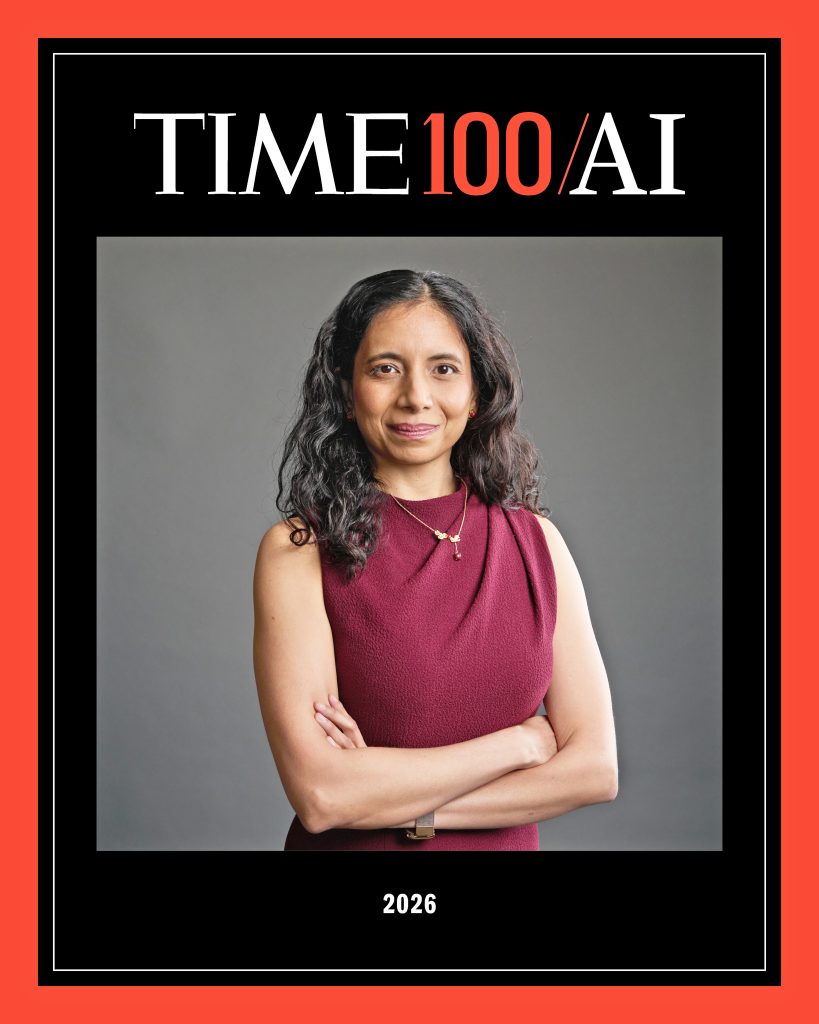
Eight Indian Americans have been recognized on TIME magazine’s 2026 TIME100 AI list, highlighting their influence across artificial intelligence, technology, scientific research, health care, policy and the future of employment. The recognition underscores the growing role of Indian-American professionals in shaping how AI is developed and applied across industries.
The honorees include IBM Chairman and CEO Arvind Krishna, National Institute of Standards and Technology Director Arvind Raman, Caltech professor Anima Anandkumar, Bayesian Health founder and CEO Suchi Saria, Micron Technology Chairman, President and CEO Sanjay Mehrotra, Encode co-executive director Sunny Gandhi, Tech Justice Law Executive Director Meetali Jain and Cognizant CEO Ravi Kumar S.
TIME organized this year’s AI list into four categories: Leaders, Innovators, Shapers and Thinkers. The categories recognize individuals whose work is influencing both the advancement of AI technology and the broader conversation surrounding its use.
Krishna has promoted more efficient AI models during his leadership at IBM while maintaining access to larger systems from companies such as Google, OpenAI and Anthropic. Mehrotra, meanwhile, represents the hardware side of the AI boom. Micron is among the limited number of companies globally producing high-bandwidth memory, a critical component used with advanced AI processors.
At Caltech, Anandkumar is using AI to accelerate scientific research. Her computational approaches can model physical processes at dramatically higher speeds, with potential applications in areas including weather prediction, medical technology, quantum computing, semiconductor production and nuclear fusion. She also serves on the United Nations Secretary-General’s Scientific Advisory Board.
Saria is applying AI directly to patient care. Her company, Bayesian Health, developed a system cleared by the FDA to continuously monitor patients and alert medical professionals when data suggests a possible risk of sepsis.
Raman focuses on evaluating advanced AI systems and examining their potential risks through his work at NIST. Gandhi and Jain bring policy and legal perspectives to the field, advocating for stronger safeguards and accountability around emerging AI technologies.
Rounding out the group, Kumar has explored how AI could reshape employment and wealth distribution, questioning long-standing assumptions about the relationship between investment and jobs.