

Introducing “Desh-Videsh 33 Years Ago”

Thirty-three years ago, in the formative days of Desh Videsh Magazine, an insightful article titled “The Non-specific Tension” graced our pages, penned by Swami Brahmavidyananda of the Saryananda Ashram in Miami. In it, Swamiji observed how a person constantly seeking escape from a life filled with real or imagined stress carries what he termed “non-specific tension.” More than three decades later, his words remain remarkably relevant—speaking directly to our modern world, where restlessness, anxiety, and the relentless search for peace feel even more urgent today.
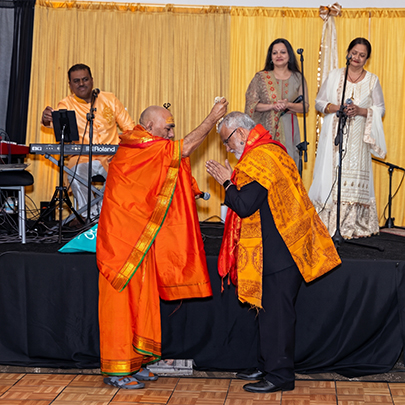 At that time, Desh Videsh was still blossoming, driven by a vision to connect, inform, and uplift our community. Having Swami Brahmavidyananda contribute his wisdom was far more than a mere editorial milestone; it marked the beginning of an enduring divine grace. From those earliest days, Swamiji’s heartfelt blessings enveloped not only the magazine—helping it grow into a trusted voice for generations of readers—but also me and my entire family. In moments of both triumph and challenge, knowing we were held in his prayers and spiritual guidance provided a steady anchor of strength, clarity, and purpose.
True grace knows no bounds of time or distance, and I feel profoundly fortunate that Swamiji’s benevolence continues to shower upon my family and me today. This lifelong bond was brought into radiant focus just recently as I celebrated my 80th birthday. Having Swami Brahmavidyananda grace the occasion with his presence and bestow his personal blessings upon me and my loved ones was an unforgettable gift beyond words. As we revisit his timeless reflections from 33 years ago, we do so with immense gratitude—honoring a spiritual luminary whose wisdom is as vital today as ever, and whose blessings remain the greatest treasure of my life.
-Raj Shah
The Non-specific Tension
by Swami Brahmavidyananda, Saryananda Ashram, Miami
A person who is constantly on the lookout for relaxation from a real or imaginary life full of tension, has a significant degree of what is called non-specific tension or NST. The major part of tension displayed by a person under NST may, however, be totally unrelated to his job or work on hand. The cause is as likely to be due to his own lack of flexibility in response to situations, ultimately leading to chronic NST.
A person with chronic NST tends to be rigid in his attitude, making him a stereotype in action. Due to a lack of flexibility in shifting levels and patterns of tension, such as a person is incapable of producing a high level of performance. Rigidity in outlook, in action and in thinking, creates a barrier to fast and subtle levels of communications with others. The person under NST is incapable of understanding the other person’s construct system, and therefore, fails to establish a sensitive communications ‘path’; subtleties and nuances, which can be the essence in certain levels of communications, get totally lost.
 The rigidity brought out by NST also effects other activities where an open mind and a flexible attitude are an advantage. The NST person finds his development gets progressively restricted. As he avoids tension situations, his role playing dwindles and the opportunity for developing new skills also dwindles. NST also effects higher levels of skills, such as subtle timing, ability to coordinate at certain levels, flexibility to take both the micro and macro view of situations…in fact, NST blunts the finer and higher executive skills.
NST affects virtually every faculty which should normally remain fine-tuned for action. Sensory processes, including visual acuity, decline; performance slows down, as a direct result of slowing the decision-making skills; irregularity in work creeps in, as more and more spontaneous pauses occur in work; and even total disorganization at work may result.
NST makes a person touchy and extremely threat-sensitive to criticism. Even an innocent remark would invite the individual’s full wrath. Other characteristics of the NST are a low self esteem, chronic unhappiness, tendency to project personal problems onto others, and a decreasing capacity to learn new or complex tasks
To the person with chronic NST, yoga opens the door to a more relaxed, alternative lifestyle. By degrees, the tension-ridden body mind complex begins to ease up, at first only during the time of actual practice, but gradually the sense of relaxation tends to linger for longer and longer after the practice is over.
An increasingly stress-free body and mind complex begins to exert its influence on the emotional aspect of stress also. The same individual, who was stress-ridden and anxiety-prone around the clock, now begins to enjoy life, and furthermore, finds that he is able to cope with occasional stresses as they arise.
Man today is sick because he thinks he is sick. Sickness and disease have no place in the man who does not accept and tolerate the self-limiting thoughts which are the real seeds of myriad ailments. We stand hypnotized by the belief that disease and illness are our fate and destiny, rather than health and bliss, which are truly our birthright and heritage. In order to emerge from our mass hypnosis and collective hysteria to experience health, joy and creative fulfillment, we must make the systematic application of yoga in our daily lives.
About Swami Brahmavidyananda
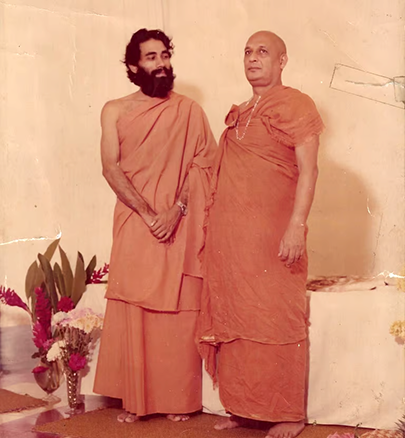
Swami Brahmavidyananda of Munger, Bihar, India, has guided thousands of spiritual aspirants, health professionals, and people from every walk of life. Swamiji is director and founder of the Institute of Holistic Yoga of North America, located in Miami, Florida.