
Cooking with Love: The Secret Ingredient in Every Indian Kitchen
By Dr. Mohini Shinde
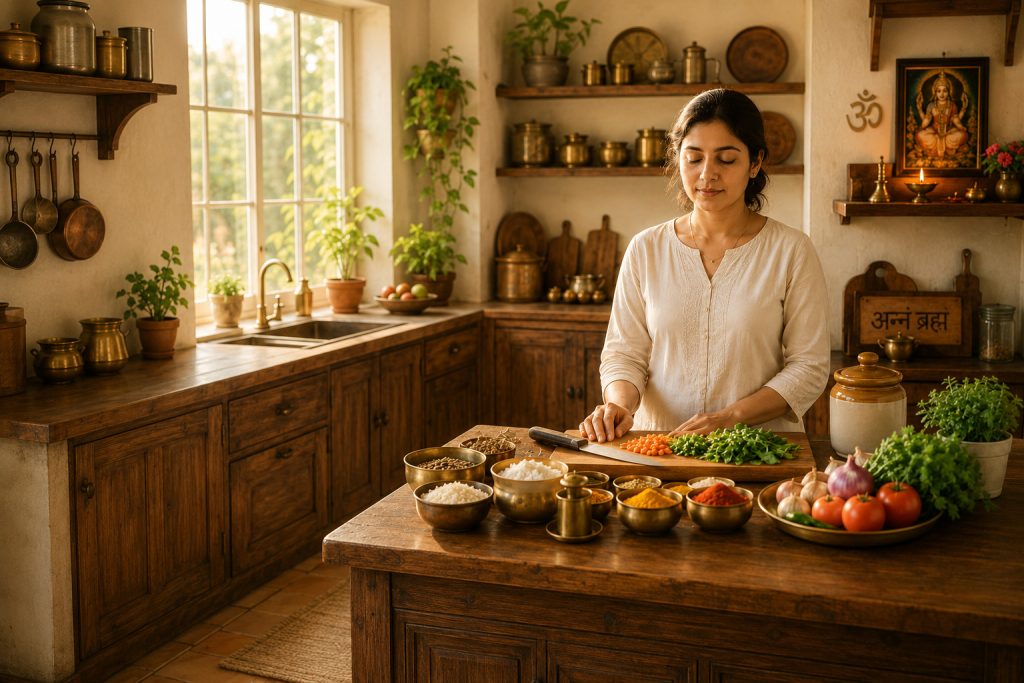
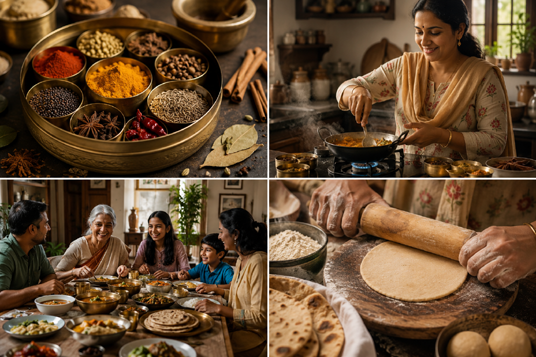
Walk into any Indian home around mealtime and you’ll notice something: the kitchen isn’t just where food is prepared. It’s where the real conversations happen. My grandmother used to say half the family history got passed down over a pot of dal, and honestly, she wasn’t wrong. The turmeric, the cumin, the cardamom pods cracking open in hot oil—all of it fills the house with something that feels less like cooking and more like a memory.
Ask anyone who’s moved away from home what they miss most. It is rarely a restaurant. It’s almost always “my mother’s cooking”—whether that means Gujarati dal, Punjabi rajma, South Indian sambar, or just plain khichdi on a lazy evening. There’s something in home-cooked food that a recipe card simply can’t capture. Call it “warmth,” call it “care”—it’s the part of the meal you can taste but never quite explain.
It’s Never Just About the Ingredients.
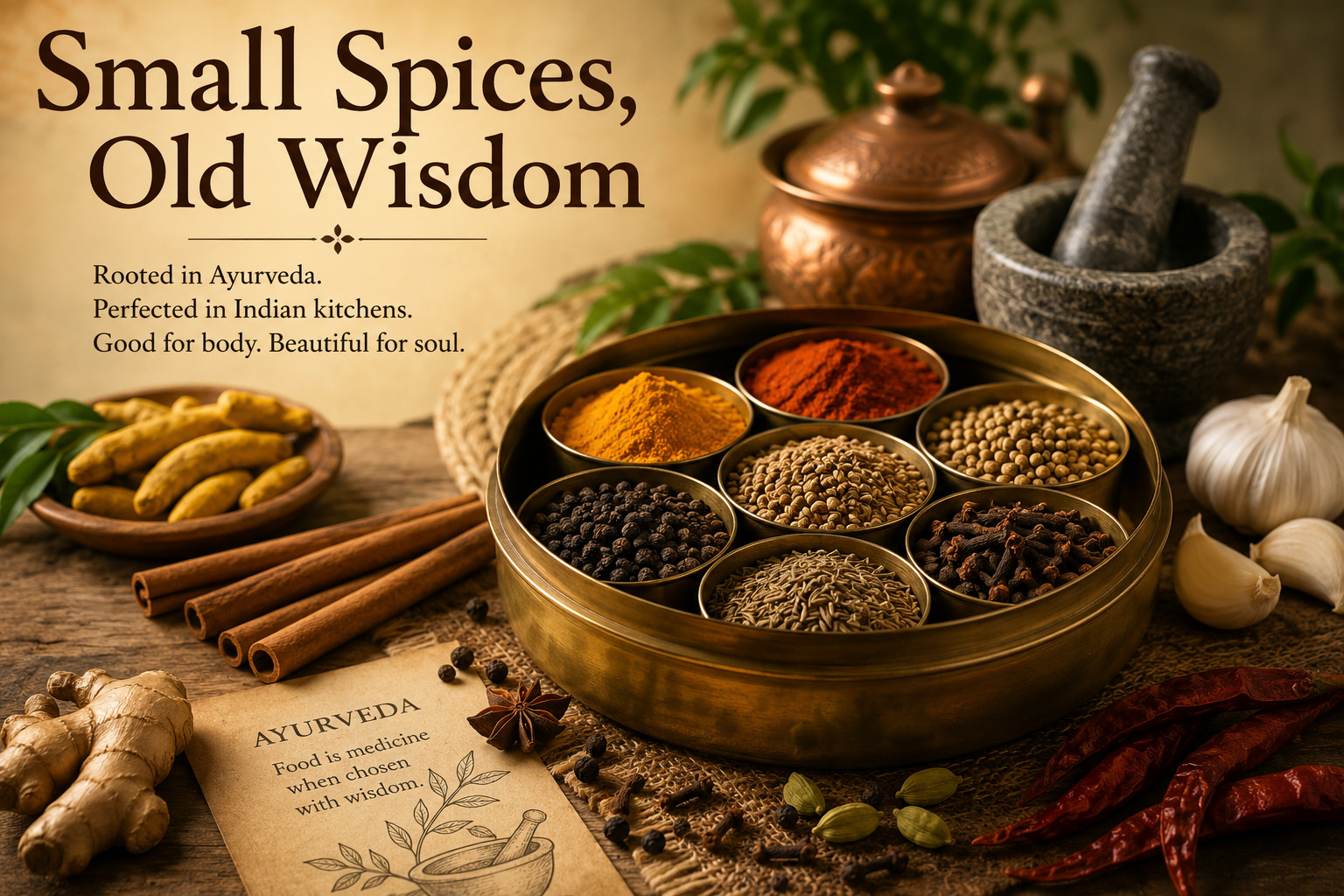 Every Indian family seems to have its version of the “same” dish. One grandmother swears by a pinch of jaggery to round out the flavor. Another won’t use anything but hand-crushed ginger. Some temper their spices in ghee, others in cold-pressed oil. None of this is inconsistency—it’s just how family recipes actually work. They carry fingerprints.
Give two people the same vegetables, the same spice box, even the same recipe, and they’ll still end up with two different dishes. The difference isn’t in what goes into the pot. It’s in who’s standing over it.
Our elders always insisted that food picks up the mood of whoever’s cooking it. I can’t prove it, but most of us have tasted the difference between a meal made with patience and one made in a hurry.
Start With a Clear Head
Before the stove even goes on, it helps to just pause for a second.
Many Indian households still begin cooking with a quick prayer, a mantra, or just a moment of quiet gratitude. It doesn’t need to be a whole ritual—even one slow breath before you pick up the knife changes something.
Try not to cook while half-checking your phone or replying to emails. Food notices when you’re not paying attention to it (or at least it tastes that way). A simple dinner prepared with genuine attention often surpasses a complex one made hastily.
Give the Ingredients Their Due
Indian cooking has always treated ingredients less like grocery items and more like small gifts.
Take a second to smell the curry leaves before they hit the pan. Before grinding roasted cumin seeds, let them rest beneath your nose. Rub a little turmeric between your fingers. Crack open a cardamom pod just for the smell of it. Listen to mustard seeds pop and skitter across hot oil—there’s a rhythm to it if you’re paying attention.
Every spice in your kitchen made a long trip to get there, usually starting with a farmer’s hands. Once you start noticing that, cooking stops feeling like a chore and starts feeling more like gratitude with a stove attached.
Small Spices, Old Wisdom
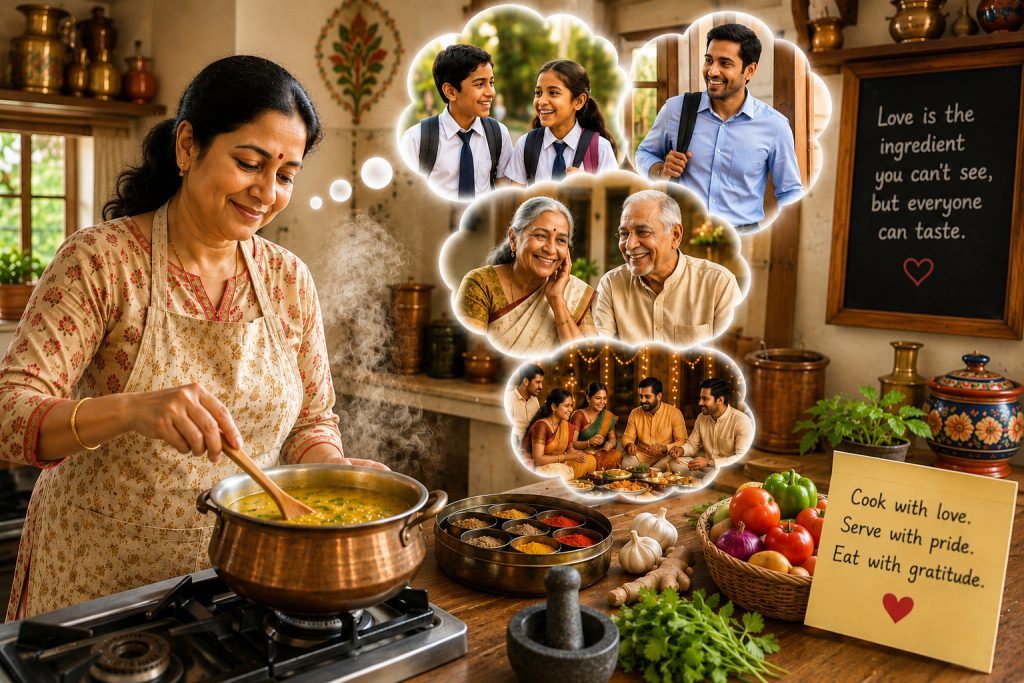 Indian spices were never just about flavor.
Turmeric brings color, sure, but also centuries of use as a healer. Cumin adds depth. Coriander smooths things out. Ginger and garlic invigorate the dish. Cinnamon, cloves, and black pepper turn an ordinary dish into something you remember. Ayurveda figured out this principle a long time ago—that spices work on the body as much as the tongue—and Indian cooking has carried that respect forward ever since.
Roast your spices slowly and they’ll thank you for it. Rush them, and you’ll taste the difference. Some things just can’t be sped up.
Cook With Someone in Mind
One of the simplest ways to bring love into a meal is to think about who’s going to eat it.
Picture your kids walking in from school, starving. Think of your spouse coming home after a long day. Remember your parents, who probably still light up at the smell of something familiar. Stir the dal and let your mind wander to a cherished memory—a festival, a family gathering, whatever comes to mind.
That feeling often manifests in the food itself.
And if you live alone, don’t shortchange yourself. We tend to pull out the good china for guests and eat instant noodles when it’s just us. It’s worth rethinking that.
Let Your Hands Do the Work
Some things shouldn’t be automated away.
Rolling out chapatis by hand. Kneading dough until it feels right, not just until a timer says so. Shaping laddus at Diwali with three generations crowded around the same table. Folding samosas together as a family activity instead of a task. Grinding chutney the slow way.
Appliances save time; no argument there. But your hands know things a food processor doesn’t—the exact moment dough stops being sticky and the give of onions cooked just long enough. You can only gain that kind of knowledge by repeatedly doing it yourself, just as your mother and her mother did before her.
Trust Your Senses Over Your Measuring Cups
 Indian cooking has never been big on precision.
How many recipes have you followed that just say “a pinch of this” or “cook until it smells right”? Our mothers and grandmothers weren’t measuring—they were listening to the tempering, watching the oil change color, and tasting as they went.
Recipes are useful. But your nose, your eyes, and your tongue will usually tell you more than a measuring spoon ever could. Food has a way of telling you what it needs if you’re willing to listen.
Eating Together Still Matters
Meals in Indian culture have always been social, not solitary.
Sunday lunches. The festival spreads. Even an ordinary Tuesday dinner can be special. Sitting around a table together does something that eating alone in front of a screen just doesn’t—conversations wander, people laugh, and stories get retold for the hundredth time.
Put the phones away when you can. If you’re dining alone, don’t just rush through your meal while standing at the counter. Sit down, serve yourself properly, and take a moment before you start eating. It changes the whole experience.
The One Ingredient You Can’t Buy
We live in a world obsessed with speed — instant meals, instant delivery, instant everything.
Cooking with love pushes back against all of that, gently. You don’t need fancy cookware or rare ingredients to make something that actually nourishes people. A humble bowl of dal and rice, made with attention, can do more for the soul than a ten-course meal made on autopilot.
So next time you’re in the kitchen, slow down for a minute. Notice the vegetables, the grains, and the spices in front of you. Say a quiet thank-you if that feels right. Cook like you mean it. Taste as you go. Share what you make.
You might find out what generations of Indian families already knew—the best thing in any dish was never something you could pick up at the store.
It was love, the whole time.
About the Author
Dr. Mohini Shinde is a distinguished scholar of religion who served as a professor of Religious Studies in India and later taught Hinduism and World Religions at several universities across the United States. Her academic work explores the contrast and interplay between Western individualism and the Hindu philosophy of collective
identity, offering deep insight into how cultural values shape personal identity, family structures, and social responsibility.
As part of her research, Dr. Shinde spent several years living in India, where she undertook immersive study of the Vedas and Upanishads, grounding her scholarship in both textual knowledge and lived tradition. Her work reflects a rare blend of academic rigor and spiritual understanding.
Now retired from formal teaching, Dr. Shinde continues to engage with readers and communities through her writing, offering thoughtful perspectives on Hindu philosophy, identity, and its relevance in the modern world.