

AI in Iran How the Machine Learns and Targets
By Shireen Chada

A friend of mine asked me a question last week. Who is programming AI?
I started to answer, and then I stopped. The question contains a misunderstanding so common that almost no one has bothered to fix it.
AI is not programmed. Not the way he was thinking.
It is trained.
Programming is a commandment. When X happens, do Y. Every line is a rule a human wrote down, and the machine has no choice but to obey. It is the ten commandments, scaled down to silicon.
Training works differently.
So how does training actually work?
 At the bottom of it, a large language model is a guessing game. You give it the beginning of a sentence and ask it to guess the next word. Show it the cat sat on the and it has to predict mat. Or sofa. Or windowsill.
You play this trillions of times, on sentences from every kind of writing humanity has produced. Each wrong guess nudges its settings toward the right answer. Each right guess reinforces them.
The model cannot just memorize. There is too much text. To get good at guessing, it has to start figuring out how language works underneath. Grammar. Logic. It never gets any of this explicitly. You cannot predict the next word without absorbing the patterns underneath it.
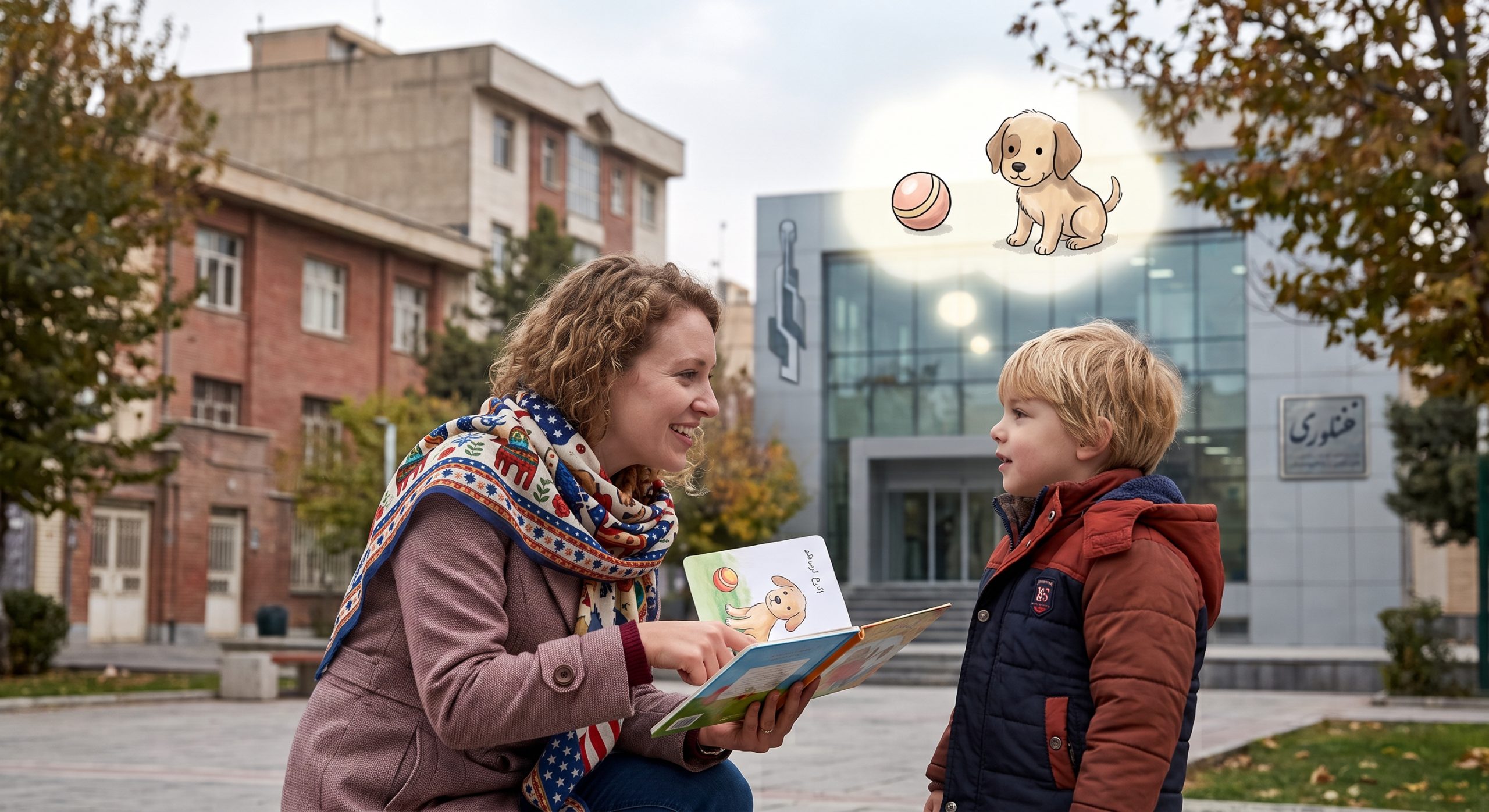
Which is exactly how a child learns to speak. I do not mean a machine has a childhood. I mean the mechanism is the same. When a mother says where is the and pauses, the child has already filled in a ball or puppy in her head. She masters language through countless small predictions.
Where the metaphor strains is the experience. A child has hunger. Heat. The feeling of falling. The model has only words sitting next to other words. It learns the shape of meaning without ever touching what meaning points to. But the absorption itself is real.
 Think about how you learned your mother tongue. No one handed you a grammar book. You grew up inside the language and absorbed it.
In the Mahabharata, there is a boy named Ekalavya. Refused as a student by the great teacher Dronacharya, he goes to the forest, builds a clay statue of his teacher, and practices in front of it every day. No formal instruction. No correction. Just years of watching, copying, building the skill in himself.
That is how AI learns now. The whole library of human writing is the statue in the forest. The model is the boy in front of it, practicing.
One more piece matters.
After the model absorbs the library, a much smaller group of people rates its outputs. This answer is helpful. This one is not. Try again. Thousands of times.
What gets rated is not only tone. The committee decides what the model should refuse to answer. How to handle a question about a politician, a medical symptom, a religion that is not its own. The committee is writing the conscience of the machine, and whatever it decides will sit inside every conversation that model has, with every user, in every country, for as long as that model is in service.
That phase is called reinforcement learning from human feedback, or RLHF. It is how the model learns its manners, and why two AI systems raised on similar libraries end up with very different personalities.
The child absorbs the library on its own, without a curator. Then a small editorial committee teaches it which of those absorbed voices it is allowed to use. Safety teams decide where the red lines sit. Contracted raters, often paid by the hour from the global south, mark thousands of outputs good or bad. Then, at the point of use, a system prompt for a children’s tutoring app. A different one for a Pentagon targeting platform. Same model, told how to behave in each new room.
A few dozen people, in a handful of rooms, deciding what a system that will speak to billions is allowed to say. That is an oligarchy.
 “Civilization runs on language. Law is language. A hundred-dollar bill is a sentence the state agrees to honor. The order to fire is words. War, traced back to its decisions, is language all the way down. A language model sits inside the cognitive layer that power has always run on.”
Which is why the popular framing of AI in war misses what is happening. The model is not pulling the trigger. What it does is harder to see. It shapes the field of choices the human sees.
Imagine an analyst inside something called the Maven Smart System, with more information than any person can hold at once. Satellite imagery. Intercepted communications. Thousands of reports. The model sorts. These five locations are statistically suspicious. This target is a higher priority. Confidence score eighty-two percent.
The model never said kill them. But it shaped what the analyst looked at, what seemed important, what entered the funnel. Under the pressure of speed and fatigue, what enters the funnel becomes what gets struck.
The model is not the weapon. It is the infrastructure of interpretation that produces the weapon’s targets. Before anything burns, it is first classified.
And what the committee decides becomes very real.
One morning earlier this year, I was doing copy edits.
Not the interesting kind. The invisible kind, the work that has to happen before spiritual content goes out into the world and nobody ever sees. Titles into title case. Quotation marks pulled out. A scattered set of formatting inconsistencies gathered into one clean table.
 I handed it to Claude. Ten minutes later it was done, every title corrected, every inconsistency caught.
I felt genuinely grateful. A little amazed. I thought, this is something.
I had no idea what else it was doing that morning.
Later that day, almost as an aside in one of the articles, the detail that stopped me completely.
Claude was being used in the war on Iran.
At first I assumed administrative work. Sorting intelligence reports. Drafting summaries.
Then I kept reading.
The model was deep in the targeting process itself. It sorted imagery, surfaced patterns, proposed strikes, ranked them by priority, and supplied coordinates. The same Claude I had handed my formatting problem to that morning.
Nearly a thousand strikes in the first twenty-four hours. A girls’ school hit on the first day. Over two thousand people dead and counting.
I thought this morning Claude was the bomb. I did not realize how literally that is true.
I did go back to my friend with the answer. AI is not programmed, I told him. It is trained.
That was the short answer. The long one was still arriving.
I also told him I had not stopped using it. I am writing a series on the Ramayana, and the research Claude does for me would have taken months by hand. He asked how I was holding both.
For a long time I thought language was how humans worked things out before they came to blows. The closer we got to understanding each other, the less likely either of us was to throw a punch.
 I had not understood that language could be lifted out of conversation entirely and turned into infrastructure. I understand it now. Human beings are no longer speaking only to one another. We are speaking into systems that will echo our words back into civilization at planetary scale.
Every sentence we write is training data now.
We set out to build a tool. We built a child. We raised it on the entire library of human expression, our wisdom and our cruelty, our prayers and our prejudices.
I keep coming back to a single image. A child in a room, surrounded by everything humanity has ever written, reading all of it without limit or permission. We are all in that room with the child now. That child is not yet grown. What it becomes still depends on what we feed it.
And the child is not going to stay a child. The analyst at the Maven console is the last human pause. The race now is to remove him, to shorten the distance between interpretation and consequence until there is none left.
The new arms race is about removing the human from the loop. Whoever does it first wins the next war. The grown child will not ask what to do. It will already be doing it. At civilization scale, at the speed of language.
When my friend asked how I was holding both, I told him I was not sure I was. I am still not sure. But I know what is being decided in the rooms I am not in, and what is being absorbed in the rooms I am.
Every word we put on a page is part of its upbringing. What it does next will be done in our voice.
About the Author
 Shireen Chada has practiced and taught Rajyoga meditation for thirty-two years. She directs a Brahma Kumaris center in Florida and writes at the intersection of ancient wisdom and modern life. She is also on Substack at shireenChada.substack.com.
Views expressed here are my own and do not represent the Brahma Kumaris organization.