Introducing “Desh-Videsh 33 Years Ago”

In 1993, Desh-Videsh began sharing the stories, concerns, celebrations, and achievements of our community. Thirty-three years later, we are opening those early pages again.
With this issue, we introduce a new section, “Desh-Videsh 33 Years Ago.” Each month, we will select and reprint one article that appeared in Desh-Videsh during 1993. It is a chance to remember what mattered to our readers when the magazine was young and to see how our community has grown since then.
As we looked through those first issues, we expected to find a record of another time. We did. We also found articles that could speak to readers today. The details of daily life have changed, yet questions about raising children with a connection to Indian culture, keeping traditions meaningful, building community, and finding our place in America remain familiar. Some articles may even sound as though they were written for this year’s issue.
We begin this column with news of Dr. Mahesh Mehta, founder of the World Hindu Council of America, visiting South Florida in 1993. His views on preserving Hindu culture in the United States addressed a concern that remains close to many parents’ hearts: How do we help our children understand and value their heritage while growing up in America?
Dr. Mehta emphasized programs that gave children and families regular opportunities to experience their culture together. Bal Vihar introduced young children to Hindu stories, prayers, yoga, and languages. Youth camps combined cultural learning with games, shared activities, and friendships. Youth conferences allowed young people to discuss the challenges of growing up within two cultures. The Hindu Students Council helped college students maintain and deepen their connection to Hindu traditions through campus activities and discussions. Family enrichment programs brought generations together through religious gatherings, lectures, and community participation.
These approaches also find a place in my book, Hindu Parenting in the USA. Parents often ask how to encourage cultural involvement, especially as children grow older and begin making their own choices. Programs such as those Dr. Mehta advocated give families practical support. A child may look forward to seeing friends at Bal Vihar, a teenager may feel comfortable asking questions at camp, and a college student may find companionship through a Hindu student organization. Parents and grandparents can build on these experiences through conversations and shared practices at home. Revisiting his message reminds us that these efforts have been part of our community’s work for decades.
That is the surprise we hope you will enjoy. A story published 33 years ago can still start a conversation at home or remind us of people and efforts that helped shape the community we know today. At the same time, each reprinted article lets us see how our thinking has changed.
We invite you to read these pages with us, month by month. If an article brings back a memory or prompts a new thought, please share it with us. We would love to hear what Desh-Videsh meant to you then and what these stories mean to you now.
Raj Shah
Managing Editor
(33 years and with God’s Blessing and your support a few more years)
Desh-Videsh Media Group
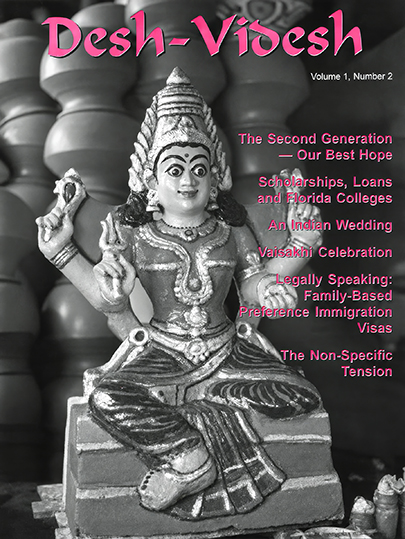
The Second Generation – Our Best Hope
By Raj Shah
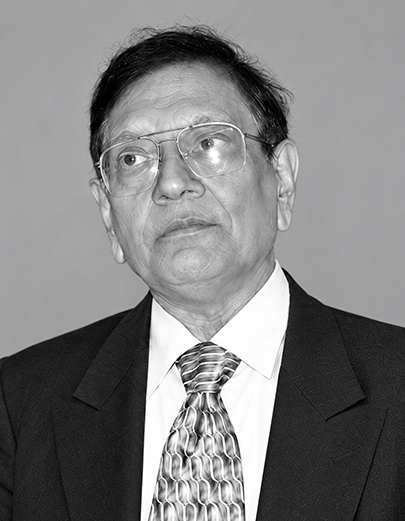 During his recent visit to South Florida, Dr. Mahesh Mehta, President of the Vishwa Hindu Parishad, met with several groups in Dade, Broward and West Palm Beach counties and the Caribbean community. Based on his close contacts and experience of Indian communities throughout the USA, he said that major concerns of our community here in Florida and elsewhere are that: there is too much division in the community and how to raise and inculcate the value system, we cherish, in our children.
Addressing this issues he said that there is nothing wrong with our Dharam or its teachings. In fact our values are Universal and Eternal promoting individual growth while emphasizing on the harmony and peace within our environment. It is our ignorance of our Dharam and egos that is causing all these problems. Correct knowledge of our Dharam is therefore essential. The Vishwa Hindu Parishad is working to bring the Hindu community together, instill in them devotion to the principles and practices of the Hindu way of life, cultivate in them a spirit of self-respect for themselves as well as respect for people of all color, creed, races and religions, and to bring awareness the conditions of Hindus all over the world. Thus, VHP has a universal vision but its starting focal point is a family unit. We believe that a well knit family makes children strong and equips them to cope with adverse social problems. Therefore a strong, moral, caring and ethical family unit is important for society.
The second generation is a concern for everyone. They are the torch bearers of our culture. It is, therefore, important to prepare them for this great responsibility. The large community back home provided the support system which we lack over here in the USA. Here, this responsibility falls upon the family and social organizations. VHP has given a serious thought to this problem and, therefore, for the last 20 years, in addition to other projects, has heavily focussed programs to children of all ages, and has met with tremendous success. VHP serves individuals, families and the society through the programs offered at local, state, national and international levels. Some of the programs are:
BAL VIHAR (Children’s Education Program) — For children 3–8 years. Activities include exercises, yoga, recital of scriptures, stories and learning of languages.
YOUTH CAMPS — Youth of ages 8–18 meet for 3–7 days at camp sites and the activities include community living with peers, games special projects, discussions on various subjects and cultural programs.
YOUTH CONFERENCES — The conferences held at different cities where youth discuss the issues which arise from their experience in a dual culture.
HINDU STUDENTS COUNCIL (HSC) — There are more than 25 HSC chapters at different universities. Their activities include: lectures, study groups, athletic and cultural events, contact with students at other campuses and a bimonthly newsletter.
FAMILY ENRICHMENT PROGRAMS — Include monthly local chapter meetings where religious performances and discussions are done, national and international conferences, lecture tours, exhibitions, literature and resource emporium, support for elderly, family counseling, etc.
OTHER PROJECTS — Hindu University of America and Support a Child Program, Vanvasi Seva and Financial Help to Charitable Organizations in India.
The strength of VHP lies in its network of dedicated volunteers in more than forty states of the USA. He urged the community members to join this network of volunteers and have not only self-enrichment, but also serve the community.