Must Read Book

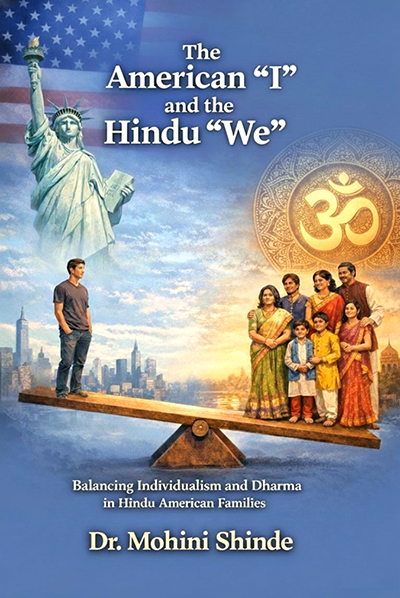 The American “I” and the Hindu “We”
Balancing Individualism and Dharma in Hindu American Families
By Dr. Mohini Shinde
What does it mean to raise children who feel fully American—yet remain deeply rooted in Hindu values?
Across the United States, millions of Hindu families live at the intersection of two powerful worldviews. One celebrates independence, self-expression, and personal choice—the American “I.” The other emphasizes dharma, family responsibility, spiritual grounding, and collective well-being—the Hindu “We.” For children growing up in this environment, identity is not divided into separate compartments but experienced as a constant, often quiet negotiation between these perspectives.
Hindu American children move fluidly between worlds. In school, they are encouraged to think critically, speak confidently, and define themselves as individuals. At home, they are guided toward respect for elders, commitment to family, moral discipline, and an understanding that life extends beyond the self. Neither set of values is inherently in conflict, yet misunderstandings frequently arise when expectations remain unspoken. What parents see as responsibility, children may perceive as pressure. What children experience as independence, parents may interpret as detachment.
For parents, this duality is both hopeful and unsettling. They want their children to thrive in an open and competitive society—to pursue careers, express opinions, and participate fully in American life. At the same time, they hope to transmit a heritage shaped by continuity across generations: language, rituals, festivals, reverence, and a sense of belonging to something larger than individual achievement. The challenge lies not in choosing one path over the other, but in learning how to integrate both consciously.
In The American “I” and the Hindu “We”, Dr. Mohini Shinde explores this integration through lived experience, cultural observation, and contemporary understanding of family dynamics. The book examines how Hindu identity evolves across generations, especially among second- and third-generation families. It looks at parenting styles shaped by Western psychology and traditional expectations, conversations about education and success, and the ways children interpret religious practice while growing up as a minority in a pluralistic society.
The discussion extends beyond the home. Schools, peer groups, media, and social narratives influence how young people understand themselves. Festivals must be balanced with academic calendars. Faith is sometimes reduced to stereotypes. Temples and community organizations attempt to reinforce what families alone cannot always sustain. Grandparents adjust to changing roles in nuclear households, while parents navigate conversations they themselves never had growing up. Each of these forces shapes how the “I” and the “We” either harmonize or drift apart.
Importantly, the book does not frame American and Hindu values as opposing choices. Individual confidence need not negate collective responsibility. Personal freedom does not erase spiritual discipline. Adaptation does not require cultural loss. Instead, Dr. Shinde presents a framework in which both perspectives coexist—strengthening identity rather than fragmenting it.
Written for parents, educators, community leaders, and young adults alike, these pages offer an invitation to reflection and dialogue. By naming the dynamics between the American “I” and the Hindu “We,” the book guides families toward clarity, understanding, and harmony—so that the next generation may grow not divided between worlds, but enriched by both.
For more information or to buy this book, please visit www.deshvideshpublishing.com.