Our Heritage: The Vedas and the Eternal Truth of India
By Samir Desai
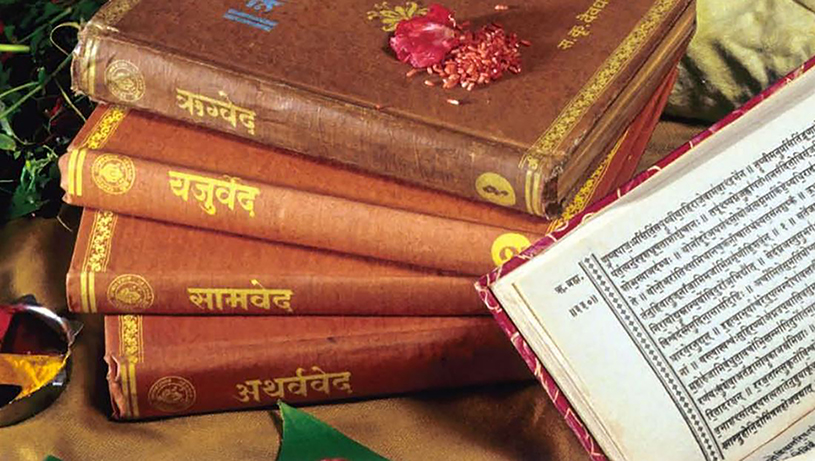
One of the most sacred collections of scriptures in India is known as the Vedas. Originally preserved through oral tradition, these divine teachings were later compiled and systematized by the great sage Rishi Vyasa. He entrusted this vast knowledge to four of his foremost disciples:
- Rishi Paila Rig Veda
- Rishi Vaishampayana Yajur Veda
- Rishi Jaimini Sama Veda
- Rishi Sumanta Atharva Veda
Together, these form the four great Vedas.
Each Veda is traditionally divided into three major sections:
- Mantra Section
This section expresses Truth in poetic form. It glorifies nature and the eternal Reality, presenting the vision of Truth as seen by the poets.
- Brahmana Section
This part explains rituals and ceremonial practices. It reflects the understanding of Truth as interpreted by priests.
- Upanishads Section
This final section explores Truth philosophically. It presents the deepest inquiry into the nature of life and existence, as seen by philosophers.
“Thus, poets, priests, and philosophers are all contemplating the same eternal Truth from different perspectives. The Vedas honor every individual’s right to independently seek and realize Truth.”
Vedanta and the Meaning of Upanishad
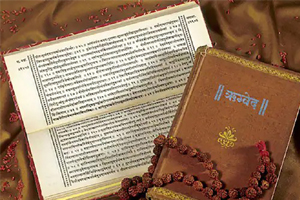 The Upanishads are considered the essence of the Vedas. Since they appear at the end of each Veda, their philosophy is called Vedanta — Veda (knowledge) + anta (end).
The word Upanishad comes from three Sanskrit roots:
- Upa — near
- Ni — below
- Shad — to sit
Thus, Upanishad means “to sit near and humbly at the feet of a teacher,” symbolizing the transmission of sacred knowledge from master to disciple.
The word Veda comes from the Sanskrit root “विद् (vid)”, meaning “to know.” Therefore, Veda means “knowledge.” The Vedas are eternal not merely as texts, but because the knowledge they convey is eternal.
Profound Vedic Declarations
- Unity of Truth
Sanskrit (Devanagari):
एकं सद् विप्रा बहुधा वदन्ति।
(Ṛg Veda 1.164.46)
Transliteration:
Ekaṃ sad viprā bahudhā vadanti.
Meaning:
Truth is one; the wise call it by many names.
- Welcoming Noble Thoughts
Sanskrit (Devanagari):
आ नो भद्राः क्रतवो यन्तु विश्वतः।
(Ṛg Veda 1.89.1)
Transliteration:
Ā no bhadrāḥ kratavo yantu viśvataḥ.
Meaning:
Let noble thoughts come to us from every direction.
Together, these two ślokas reveal a beautiful vision of oneness and harmony. We are urged to welcome knowledge from all traditions, philosophies, and faiths, because the eternal Truth is one, though known by many names.
Vision of Universal Unity
This timeless idea is also beautifully expressed in the Mahā Upanishad: The Mahā Upanishad is a lesser known but important philosophical text belonging to the Atharva Veda tradition.
Sanskrit (Devanagari):
वसुधैव कुटुम्बकम्।
Transliteration:
Vasudhaiva kuṭumbakam.
Meaning:
The whole world is one family.
Since Veda means “knowledge,” Sanātana Dharma is, at its heart, a reverence for knowledge itself — a sacred pursuit of truth, wisdom, and enlightenment. The central purpose of the Vedas is to affirm the unity of mankind. Let harmony begin within India and then spread across the world.
“This is the grand and timeless vision of our Rishis — a world guided by wisdom, unity, and eternal Truth, as revealed in the Vedas.”
About the Author
 Samir (Sam) Desai was with Motorola for more than 34 years. He served as Sr. Vice President & General Manager for iDEN® Networks, managing over six billion dollars’ worth of business.
He has a MS in electrical engineering from the Illinois Institute of Technology, Chicago. He also holds an MBA from Loyola University, Chicago. He is known as a management guru who has applied principles from the Bhagavad Gita in the corporate world.
After retiring from Motorola, Sam Desai served as an independent consultant for the Board of Directors of three companies: Larsen & Toubro Infotech, Larsen & Toubro Technology Services, and Welch Allyn.